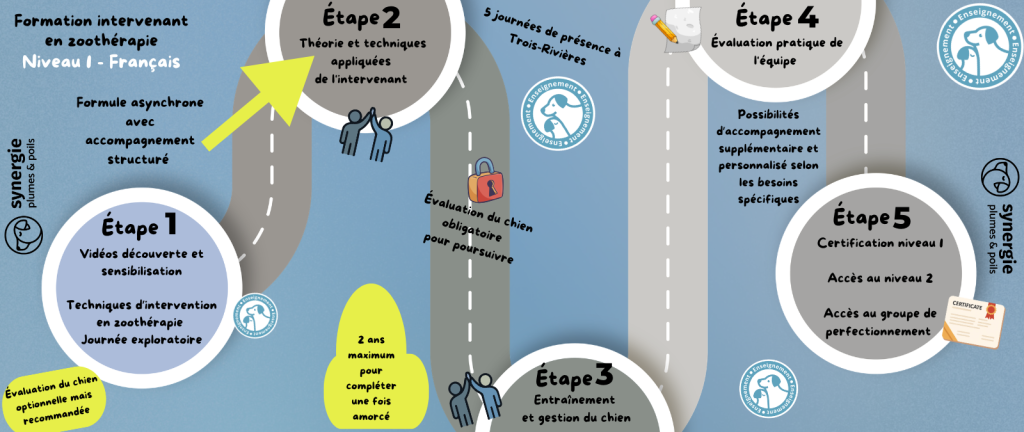
Welcome to Step 2.2 of your journey!
We are happy to support you in this new stage of your professional development!
Observe, reflect, and integrate with a precise methodology – that’s what you can expect in this step!
After exploring the animal partner, its well-being, its communication, and the criteria for thoughtful selection, it’s now time to delve deeper into understanding animal-assisted intervention.
This step will allow you to develop a more comprehensive view of the practice by working on both the foundations of intervention and the observation of the various actors involved. A good practitioner does not merely apply activities or techniques.
They understand current needs, analyze situations, and adapt their choices based on the client, the animal, and the intervention context.
In this step, we will cover:
– the different angles of integrating zootherapy according to client needs, field definitions, and your professional role
– the observation of the triad’s actors: the client, the animal partner, and the practitioner
– the discovery of the N1 methodology, both its theoretical foundations and its practical application
– the links between observation, clinical reflection, and intervention choices.
We will conclude this step with a comprehension coaching session aimed at consolidating your learning, validating your observations, and supporting the integration of the method into your practice.
Because intervening with an animal is not just about being accompanied by an animal partner. It’s about learning to observe, reflect, and intervene consciously, coherently, and professionally.
Welcome to this new stage of your journey!
Duration: 16.5 hours
Welcome to Step 2.2!
A quick word to introduce what’s behind Step 2.2!
VI1 – Zootherapy in a multidisciplinary team
Welcome to this first step of the intervention component
Before even considering the animal’s contribution. Before exploring the added value of the animal in an intervention context, it is essential to fully understand the framework in which it will be introduced. This means first knowing our role, our scope of practice, and our limits, but also understanding those of the professionals with whom we are called upon to collaborate.
Knowing their vocabulary, approaches, needs, objectives, and the types of interventions they perform allows us to create links between their expertise, our role, and the possibilities the animal offers. This understanding is essential for reflecting on the actual place the animal can take within a team and in an intervention.
It allows us to move beyond simple animal presence to build thoughtful, relevant interactions directly linked to the needs and objectives pursued. Before asking what the animal can do, we must first understand where, why, and with whom it intervenes.
Duration: 4 hours
VI-2 Observation in Zootherapy
Looking is not observing. Simply watching an interaction is not enough. To observe is to know where to focus your attention, what to measure, and how to interpret what is happening.
Human-animal interactions can be very fast-paced.
Without precise benchmarks, valuable information can escape us: a change in behavior, an animal’s response, a human’s adjustment, or an element that could influence safety.
Structured observation increases efficiency, precision, and safety, while giving real value to interactions.
Duration: 7.5 hours
VI-3 Intervention Techniques in Zootherapy – Implicit N1
An implicit structure. At N1, the interaction is based on an implicit structure.
Even if it may seem natural and spontaneous to the client, the practitioner must know where they are going. They must know the elements that will compose the interaction, while being able to adjust to the client’s and animal’s responses as they appear.
The practitioner then becomes the conductor of the interactions: guiding, observing, adjusting, and protecting them so that they remain relevant, safe, and beneficial for everyone.
The structure is invisible to the client, but very present in the practitioner’s mind.
Duration: 4 hours
Step 2.2 Coaching
Come become aware and appreciate that you are progressing in your journey as a zootherapy practitioner
Duration: 1 hour
**The pricing for Step 2.2 does not include this coaching. It must be booked and paid for separately.**
Conclusion Step 2.2
Congratulations! You’re finishing Step 2.2 and are now ready for what’s next. We are pleased to present Step 2.3!